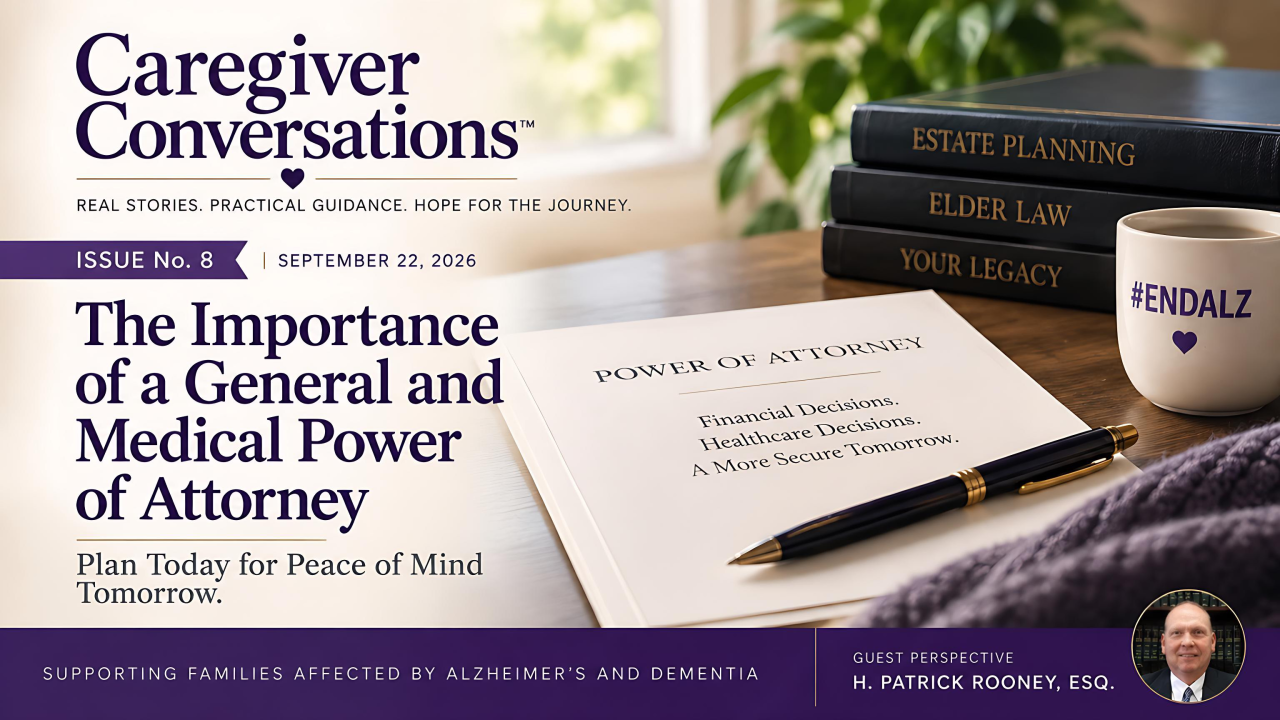
The Importance of a General and Medical Power of Attorney

by Pat Rooney , Esq, Civil, Criminal Law and Succession Law

Editor’s Note: H. Patrick Rooney, Esq. shares an important reminder for families facing Alzheimer’s disease or dementia: some of the most consequential decisions are best made before a crisis makes them urgent.

The worst time to make important legal and healthcare decisions is in the middle of a crisis.

One of the most important steps a person can take after a diagnosis of Alzheimer’s disease or dementia is to consider executing both a General Power of Attorney and a Medical Power of Attorney.

These documents are important planning tools for every adult, but they can become especially important after the discovery of an unexpected condition that may eventually affect a person’s ability to manage his or her own affairs or make and communicate important decisions.

Planning early gives the individual an opportunity to decide who he or she trusts to help when that help is needed.

Two Documents With Different Purposes

In Louisiana, a power of attorney is commonly referred to as a mandate or procuration. A General Power of Attorney allows a person, known as the principal, to designate another trusted individual to act on his or her behalf.

Depending upon the authority granted in the document, that person may be able to handle banking and financial matters, pay bills, manage investments, deal with insurance, handle business affairs, sign documents, and manage property.

A Medical Power of Attorney, sometimes called a Healthcare Power of Attorney or healthcare mandate, serves a different but equally important purpose.

It allows a person to designate someone he or she trusts to make healthcare decisions when the person is no longer capable of making or communicating those decisions. Depending upon the authority granted, the representative may communicate with physicians, consent to or refuse medical treatment, obtain medical information, make decisions concerning medications and procedures, and assist with decisions involving hospitals, rehabilitation facilities, assisted living, or nursing-home care.

For families, understanding that distinction matters. One document addresses important financial and personal affairs. The other addresses healthcare decisions. Together, they can help families prepare for circumstances they hope never occur.

The Most Important Question May Be When

Perhaps the most important consideration is not simply whether these documents should be executed, but when.

A person should not wait until serious cognitive decline has occurred before addressing a power of attorney. The time to plan is while the individual still possesses sufficient mental capacity to understand the nature and consequences of the document being signed.

A diagnosis of Alzheimer’s disease or dementia does not necessarily mean that a person immediately lacks the capacity to execute legal documents. However, as the disease progresses, there may come a point when the individual can no longer adequately understand the document or the authority being granted.

Waiting too long can mean waiting until it is too late.

A notary or attorney cannot simply have someone execute a valid power of attorney when that individual no longer possesses the legal capacity necessary to understand what he or she is signing. At that stage, the family may be forced to consider court proceedings to obtain authority to handle matters for the incapacitated individual, something that proper advance planning may help avoid.

Have the Conversation While Your Loved One Can Be Part of It

This is especially important for families confronting Alzheimer’s disease or dementia.

During the early stages, when the individual can still understand his or her circumstances and express personal wishes, families should consider having conversations about financial management, medical treatment, long-term care, and who should be trusted to make decisions if the disease progresses.

These conversations are not always easy. But having them early gives the person at the center of the decisions an opportunity to participate in them.

A Medical Power of Attorney can provide tremendous reassurance because the individual, not a crisis and not simply circumstances, has chosen the trusted person who will speak for him or her when that voice is needed most.

That can be an important gift both to the individual and to the family members who may one day be asked to carry out those wishes.

Plan Today, Rather Than During an Emergency Tomorrow

The lesson is simple: do not wait for incapacity to begin planning for incapacity.

Executing appropriate General and Medical Powers of Attorney while a person retains the necessary cognitive ability can help protect that person’s independence, property, healthcare wishes, and family.

Most importantly, it allows important decisions to be made thoughtfully today rather than during an emergency tomorrow.

If your family is facing an Alzheimer’s disease or dementia diagnosis and these documents are not already in place, consider discussing them with an attorney while your loved one can still fully participate in the conversation.

ABOUT

H. Patrick Rooney, Esq, Civil, Criminal Law and Succession Law

Pat Rooney is Managing Partner of Southern Legal Clinics, which is a private, local, family run law firm, and he has practiced law for more than 35 years. A lifelong New Orleanian and graduate of LSU Law , his law practice includes wills, powers of attorney, successions, probate and estate planning. He and Southern Legal have spent decades helping families throughout Southeast Louisiana navigate some of life's most important legal decisions.

H. Patrick Rooney, Esq, Southern Legal Clinics, 3200 Ridgelake Drive, Suite 204, Metairie, LA 70002 | 504-455-4185 | pat@southernlegalclinics.com

This article provides general educational information and is not intended as legal advice. Laws and individual circumstances vary. Families should consult an attorney regarding their particular situation.

The Conversation You Can’t Afford to Put Off

By H. Patrick Rooney, Esq.

When someone you love is diagnosed with Alzheimer’s or another form of dementia, your first thoughts probably aren't about wills, powers of attorney or legal documents. You're thinking about the person you love. What happens next? How quickly will things change? What kind of help will they need? And how will our family get through this together?

Those are natural questions. But after more than 35 years practicing law and helping families throughout the New Orleans area with wills, powers of attorney, successions and estate planning, there is another conversation I encourage families to have sooner rather than later: What does your loved one want to happen when the day comes that he or she can no longer make important decisions independently?

It's not an easy conversation. But planning is much easier when families begin before there is a crisis. With Alzheimer's and other dementias, waiting can eventually take choices away from the very person whose wishes you're trying to protect.


A Diagnosis Doesn't Take Away Their Voice

An Alzheimer's diagnosis does not automatically mean someone can no longer participate in legal decisions. If your loved one has the legal capacity required for a particular decision or document, he or she should be part of the planning.

Your mother may know exactly whom she trusts to handle her finances. Your father may have strong feelings about the medical care he would want. Your spouse may know exactly who should speak on his or her behalf if that becomes necessary.

Giving them the opportunity to tell you is important because dementia changes over time. The conversation your family can have today may become much more difficult later.


Start With the Conversation

People sometimes come into my office thinking estate planning is all about paperwork. The paperwork certainly matters, but good planning begins with a conversation.

Who does your loved one trust? Who should handle financial matters if they eventually cannot? Who should make healthcare decisions? What are their wishes about medical treatment? Do they already have a will, power of attorney or living will? And when was the last time those documents were reviewed?

You don't have to answer every question in one afternoon. These can be emotional conversations, and families may need time to think about what they've discussed. The important thing is to begin while your loved one can still participate meaningfully.

Several legal documents may become important. A durable power of attorney can authorize a trusted person to handle financial and other matters. A healthcare power of attorney can identify who should make medical decisions when someone is no longer able to do so. A living will can communicate wishes involving certain medical and end-of-life decisions, while a standard will addresses what happens to someone's estate after death.

Depending on the circumstances, other estate-planning tools may also be appropriate. Caregivers don't need to become legal experts. What families do need to understand is that these decisions are much easier to address while the person living with dementia can still tell everyone what he or she wants.

Choosing the right people is just as important as preparing the right documents. Someone entrusted with financial or healthcare responsibilities should be trustworthy, responsible and willing to honor your loved one's wishes. It's also wise to consider a backup because families and circumstances change.

Existing documents deserve another look, too. A will or power of attorney prepared 10 or 15 years ago may no longer reflect someone's wishes today. Relationships change. Circumstances change. Sometimes the person we trusted years ago isn't the person we would choose now.


Don't Wait for a Crisis

I understand why families put this off. Nobody particularly wants to sit around the kitchen table talking about incapacity, declining health or what happens at the end of life. There always seems to be another day to deal with it.

Unfortunately, dementia doesn't work according to our timetable.

If someone eventually loses the legal capacity required to execute important documents and adequate planning hasn't occurred, the family's options can become more limited. In some circumstances, court involvement may become necessary. That can mean additional time, expense and stress for a family already carrying a tremendous emotional load.

Planning ahead won't make Alzheimer's easy. But it can remove some uncertainty from the road ahead. It can help families understand who will make decisions, reduce the possibility of disagreements and, most importantly, preserve the wishes of the person living with the disease.

If Alzheimer's or another dementia has entered your family's life, don't begin by worrying about every legal document you might eventually need. Begin with the person you love. Sit down together, ask what they want and listen carefully. Then get appropriate legal guidance and put the plans in place that are right for your family.

Because someday your family may have to make decisions for someone you love.

Today, you may still have the opportunity to make those decisions with them.


About

H. Patrick Rooney, Esq. is Managing Partner of Southern Legal Clinics, which is a private, local, family run law firm, and he has practiced law for more than 35 years. A lifelong New Orleanian and graduate of LSU Law School, his law practice includes wills, powers of attorney, successions, probate and estate planning. He and Southern Legal have spent decades helping families throughout Southeast Louisiana navigate some of life's most important legal decisions.

H. Patrick Rooney, Esq, Southern Legal Clinics, 3200 Ridgelake Drive, Suite 204, Metairie, LA 70002 | 504-455-4185 | pat@southernlegalclinics.com

This article provides general educational information and is not intended as legal advice. Laws and individual circumstances vary. Families should consult an attorney regarding their particular situation.